

Are Your Business’s Records & Minute Books Up to Date?
If you operate a corporation, one critical question you should ask is: Are your corporate records and minute book up to date?
If they are not, the consequences can be serious, ranging from higher taxes and penalties during a CRA audit to significant obstacles when selling your corporation or purchasing real estate.
Many business owners overlook corporate record maintenance until it becomes a problem. By then, it may already be too late.
What Is a Corporate Minute Book?
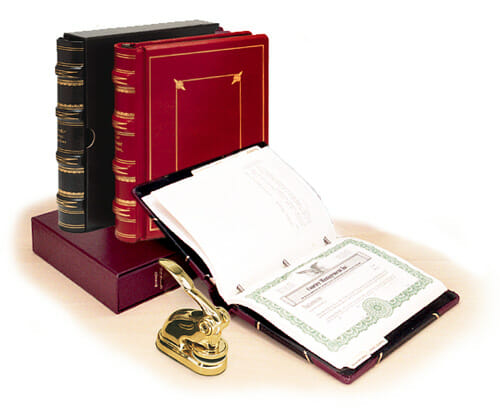
Under the Ontario Business Corporations Act (OBCA) and the Canada Business Corporations Act (CBCA), every corporation is legally required to maintain a corporate minute book.
The minute book must contain, in one place:
- Articles of Incorporation
- Extra-provincial registrations (if applicable)
- Corporate by-laws
- Organizational resolutions of directors and shareholders
These resolutions identify key corporate details, including:
- Directors and officers (President, Secretary, CEO, etc.)
- Fiscal year-end
- Corporate accountant
- Corporate bank
- Corporate lawyer
- Shareholders and share structure
Together, these documents form the official legal history of the corporation, and maintaining them is not optional; it is required by law.
Corporate Books and Records Under the Income Tax Act
In addition to corporate legislation requirements, the Income Tax Act imposes separate record-keeping obligations.
Corporations must maintain:
- Bookkeeping and accounting records
- Income and expense ledgers
- Supporting documentation for assets and deductions
- Logs for specific assets, such as corporate vehicles
These records must be:
- Legible
- Complete
- Retrievable
- Available for inspection by the Canada Revenue Agency (CRA) at any time
Most corporations maintain these records through accounting software, spreadsheets, or physical books.
What Happens During a CRA Audit?
If your corporation is audited, the minute book is typically one of the first documents requested, followed by the financial books and records.
If these records:
- Do not exist
- Are incomplete
- Cannot be retrieved
You may receive an audit proposal letter, which can result in:
- Reassessed and higher taxes
- Interest charges
- Penalties for non-compliance
In serious cases, failure to maintain proper records may expose directors and shareholders to further scrutiny.
Why Proper Corporate Records Matter Beyond Audits
Maintaining a complete and accurate minute book is essential for many business transactions, including:
- Purchasing or financing real estate
- Selling the corporation or its shares
- Proving share ownership
- Demonstrating corporate authority to third parties
Without properly issued share certificates and resolutions, you may be unable to prove that you own the corporation, even if you are listed as a director.
Prospective buyers or lenders may walk away entirely if they discover that proper records were not maintained, as this often signals poor corporate governance and hidden risk.
Can You “Fix” a Minute Book After the Fact?
Many clients ask whether they can simply create or update the minute book when the CRA or a purchaser requests it. In most cases, this is not advisable.
The CRA has tracing methods capable of identifying backdated or falsified documents. If records are improperly recreated or dated retroactively, this can lead to:
- Severe penalties
- Allegations of falsifying records
- Potential criminal prosecution
Similarly, a purchaser may refuse to proceed once it becomes clear that corporate records were not properly maintained.
How Kalfa Law Firm Can Help Get Your Corporation Back in Order
If your corporate minute book is not up to date or was never prepared, we can help.
Updating Incomplete or Outdated Minute Books
We can prepare ratifying and rectifying omnibus resolutions, which:
- Confirm that prior acts were intended but undocumented
- Retroactively approve past corporate decisions
- Bring your corporation into legal compliance
Reconstructing Lost or Missing Minute Books
If no minute book or share certificates exist, we can:
- Prepare a statutory declaration explaining the absence of records
- Reconstruct the corporate history
- Issue proper share certificates
- Prepare a complete, physical minute book
Ongoing Corporate Record Maintenance and Annual Resolutions
Regardless of your corporation’s current state, annual resolutions are required every year.
Annual resolutions typically:
- Approve the corporation’s financial statements
- Confirm directors and officers
- Authorize year-end tax planning decisions
These resolutions are based on financial statements prepared by your accountant and used to file the corporation’s T2 corporate income tax return.
Year-End Resolutions and Tax Efficiency
Annual resolutions may also authorize:
- Capital dividends from the Capital Dividend Account (CDA)
- Eligible dividends from the General Rate Income Pool (GRIP)
- Non-eligible dividends from the Low Rate Income Pool (LRIP)
- Share redemptions
- Management bonuses and other compensation strategies
Properly documented resolutions allow retained earnings to be extracted in the most tax-efficient manner possible.
How We Coordinate With Your Accountant
To ensure compliance, our firm typically:
- Contact your accountant approximately three months after the fiscal year-end
- Reviews financial statements and balance sheets
- Prepares annual director and shareholder resolutions
- Draft any required year-end tax planning resolutions
This process ensures your corporation remains in good standing and audit-ready.
If your corporate minute book is outdated, incomplete, or nonexistent—or if you are unsure of its status, now is the time to act.
Kalfa Law Firm can help you update, reconstruct, and maintain your corporate records properly and efficiently. Contact Kalfa Law Firm today to ensure your corporation is compliant and protected before issues arise.
FAQs:
Shira Kalfa, BA, JD, Partner and Founder
© Kalfa Law 2020. Updated May 2026.
The above provides information of a general nature only. This does not constitute legal advice. All transactions or circumstances vary, and specified legal advice is required to meet your particular needs. If you have a legal question you should consult with a lawyer.